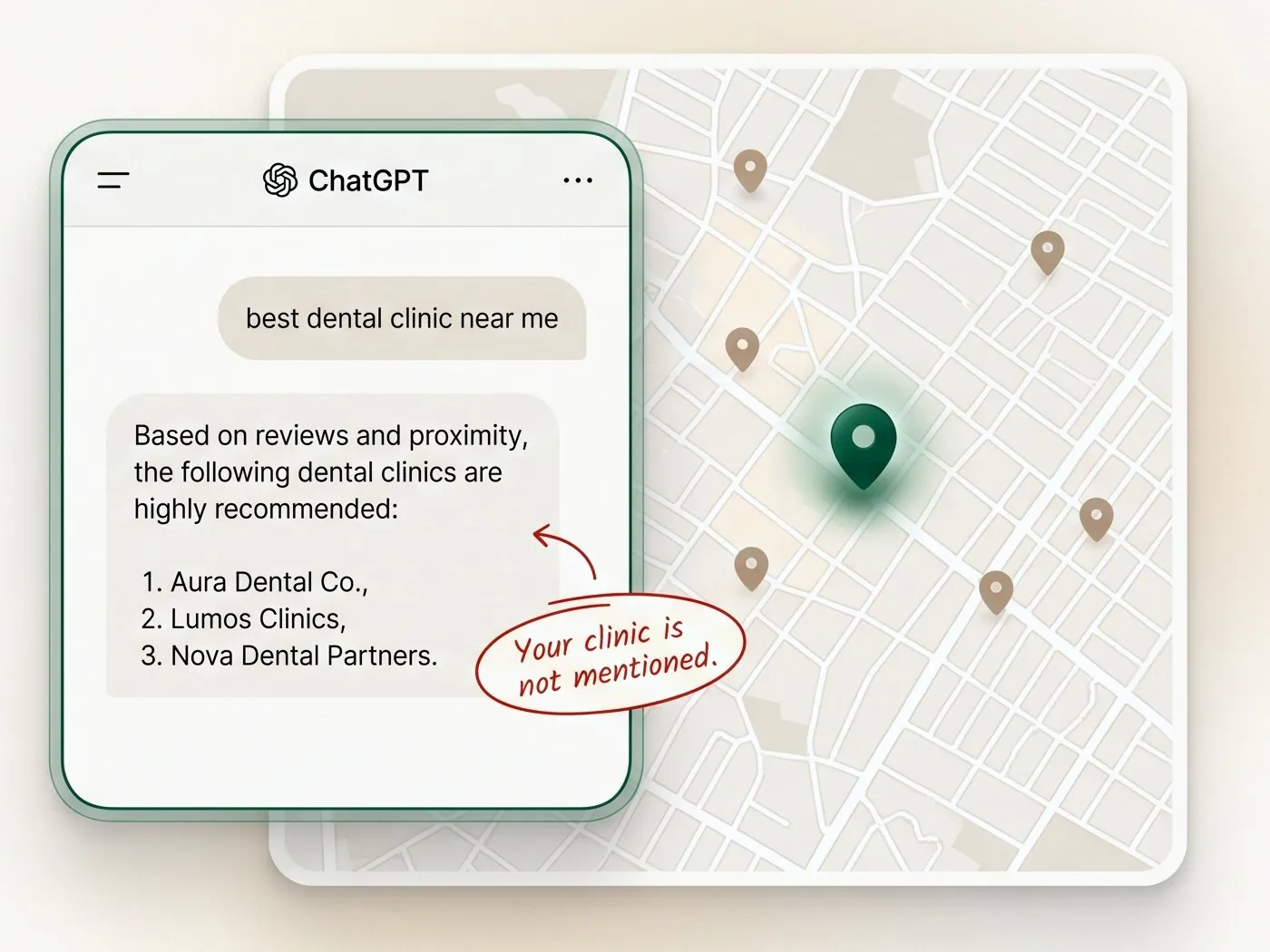
What it looks like
Right now, AI names three competitors. You're not in the answer.
The 90-day goal: your locations inside the answer, with addresses and links.

SEO + AI visibility · US · UK · CA · AU
Dental groups, clinics, gyms, restaurants, franchises with 5+ locations. People ask AI "what's good near me" and go where it points them. We'll check for free whether your addresses show up in those answers.
One business day. No call required. A specialist replies, not a sales rep.
We track six engines, separately for every address
What it looks like
Right now, AI names three competitors. You're not in the answer.
The 90-day goal: your locations inside the answer, with addresses and links.

The gap, measured by someone else
of multi-location brands' addresses get named by ChatGPT in answers to local queries
SOCi Local Visibility Index 2026 · 350,000 locations
of those same brands rank in Google's map 3-pack. Their local SEO works. AI answers still skip them
SOCi 2026 · Gemini 11%, Perplexity 7.4%
growth in one year in the share of people asking AI about local businesses
BrightLocal, Local Consumer Review Survey 2026
Who it's for
Every location is its own entity with its own data, reviews and competitors. We work each one individually, not the brand as a whole.


The mechanism

01 · Location data
The model has to know the location exists: consistent data across platforms, schema markup, a location page, and access for AI crawlers.

02 · Extractability
The answer has to lift out easily: what you do here, for whom, what it costs, how to book. Short, and on the location page.

03 · Local consensus
Third parties have to vouch for the location: reviews, city roundups, directories, discussions. That turns a mention into a recommendation.
What we are not
Listings platforms keep location data clean. That's the foundation, and we build on it. We work one layer up.
| Listings platform | Citemill | |
| Data hygiene: addresses, hours, categories | yes | we build on it |
| Measurement: how often AI names each location | — | yes, monthly |
| Placements in media that AI actually cites | — | yes |
| Content for neighborhood-level queries | — | yes |
| Classic SEO for location pages | partial | yes |
The method
Weeks 1–2
Network audit, neighborhood query set, baseline measurement across all engines and locations.

Weeks 3–6
Location data, schema, location pages, crawler access. Day-45 measurement.

Weeks 5–8
Neighborhood content: the comparisons and roundups models pull their lists from.

Weeks 9–12
Local consensus: directories, city media, reviews. Day-90 assessment.

What you get
A measurement for every location and engine, competitors named, citation sources, and a 90-day plan. It stays yours even if we never work together.
| Free check: 3 addresses, one engine | $0 · 1 business day |
| Answer Share Audit™: full network, 6 engines, plan credited toward your first program month | $2,900 · 10 business days |
Pricing
Complete program
recommendedMonth to month, no lock-in. At 11+ locations the rate drops 20% on every location; at 26+ it's $410/location. All prices published.
| Essential · $4,800 | Complete · $7,500 | |
| Location data, schema, location pages | yes | yes |
| Engines monitored | 4 | 6 |
| Reporting | monthly | + experiment log |
| Neighborhood content | — | yes |
| Local consensus: placements, media | — | yes |
| Review pipeline | — | yes |
By day 45, at least one engine names at least a third more of your locations than at baseline, or we refund your first month in full. Everything we built stays with you.
Day 45
We measure what we control: data and structure. The run happens with you watching, and the exports are yours.
The rules
Queries, engines, cities and the definition of "named" are fixed before the start and never change. "A third" is counted from the number of locations in the program, rounded down; from a zero baseline, a third of the network.
Honestly
Nobody can guarantee a specific AI answer. Anyone promising that is selling certainty that doesn't exist.
Optional: everything you need is already in the program. These are the prices if you want to move faster than the plan.
| Placement on a source AI already cites for your city fully our work; we answer for the source being in the cited pool | $350 |
| One link placement: outreach, agreement, publication control if the site charges a fee ($100–1000, it varies), their invoice goes to them directly and is approved before we start; free sites cost nothing extra | $250 |
| Feature in a city publication | $500 |
| Inclusion in a city roundup | $200 |
| Additional language or country | $1,200/mo |
The price boundaries, so month three holds no surprises.
| Paid-media budgets: invoiced to you directly, zero markup | direct |
| Tool licenses beyond our stack | at cost |
| Web development: we write the spec, your team implements | separate |
| Replying to reviews, done by your staff | — |
Payment by card or bank transfer against an invoice. Month to month, no lock-in.
Who's behind it
In agency marketing since 2015: first an email agency with clients like Kaspersky Lab and GNC, then a marketing and PR agency: 800+ campaigns and a team that grew to 55 people. My job was getting hundreds of publications and writers to cover brands, in tech startups, where convincing an editor is harder than a city outlet.
That skill is the point here: local consensus, placements in the media AI cites, is the slowest and most expensive part of the program. For me, it's the most familiar one.
Pilot pricing for the first three networks. This niche is two years old and we're entering it alongside the market: early clients get the program cheaper and become our public case studies, with veto power over the numbers.
Public benchmark
A live run from September 1, 2026, query "best dental clinic in Austin TX". Every month we publish the full benchmark of 20 networks in the category. It's the same data our clients get.
| ChatGPT | Perplexity | |
| Austin Cosmetic & Implant Dentistry | #1 | — |
| The Local Dentist | — | #1 |
| Forest Family Dentistry | yes | yes |
| Lucent Dentistry | — | yes |
| Toothbar | — | yes |
| Smile 360 Family Dentistry | yes | — |
| 12 Oaks Dental | yes | — |
| Austin Dental Spa | yes | — |
Of the eight networks named, only one appears in both engines. Coverage has to be built engine by engine. Full run transcripts available on request.
Territories
If we take a dental group in Austin, we won't take a second Austin dental group while we work with the first. The registry updates as territories get claimed.
FAQ
About half of it isn't, and that's the honest answer. Data consistency, schema, location pages and reviews are needed either way. The difference is three things: page structure built for answer extraction, treating every location as its own entity, and local consensus: what the model sees about you on other people's sites, city by city.
Plus a different measurement system: not map rankings, but how often AI names you in answers, against a fixed query set for every neighborhood.
No, and that matters. Those platforms keep your data clean: addresses, hours, categories across dozens of sites. That's the necessary foundation, and if you have it, we start faster.
But clean listings don't answer whether AI recommends your location. We work one layer up: answer share, citation sources, local consensus. We use the platform as a data source, not a competitor.
We see and report AI referral traffic: ChatGPT tags its links with utm_source=chatgpt.com, and Perplexity and Copilot show up in referrers. But for local businesses that's the smaller part of the journey: more often AI names your brand and address in plain text, the person walks in or calls, and no click ever reaches analytics. So we measure clicks, but we won't promise total revenue attribution.
The honest way to think about it: divide the program cost per location, and estimate how many extra visits per month each location needs to break even. If that number looks unrealistic for your category, don't start. We'll tell you the same thing on the call.
Yes, and it's often the right move. We take 5–10 locations in one region, run the full cycle to day 90, and compare against a control group of your own locations we didn't touch. It's the most honest way to test us on your own data.
At the start: one call to agree on the query set and hand over access, about two hours. After that, the owner or marketer spends 2–3 hours a month approving materials and reviewing the report. Your developer spends 6–10 hours once in the first six weeks implementing technical fixes, then occasional small items.
Industry benchmarks: data and structure shifts in 3–6 weeks; a visible change in answer share in 3–4 months, because local consensus builds slowly.
The only deadline we back with money is the day-45 checkpoint.
That's the point of the program. AI changes too fast to set up once and forget, so we work continuously: tracking changes across every engine, catching new algorithms, re-running the measurement and adjusting the plan every month. No extra charge; that is the work. And the foundation survives any model version: the location has to be findable, the answer has to extract cleanly, and other people have to write about you.
For a 10-location network on Essential: $2,900 for the audit + $4,800 × 3 = $17,300. On Complete: $2,900 + $7,500 × 3 = $25,400. The only thing on top is external media budget, if you approve any.
We work under contract, paid by card or bank transfer against an invoice; payment details come with the contract before the start. Every deliverable belongs to you from the moment of payment, unconditionally, whether or not we continue.
We'll show you who AI recommends in those neighborhoods instead of you. One business day, free, no call.
One network per category per city: if an Austin dental group is already with us, we won't take a second one.